Roof Flashing Repair Jacksonville FL
Flashing is the metal that makes roof transitions watertight. It is also where a large share of leaks begin, because sealants age faster than the roof covering around them.
The short answer
What to know first
Every place the roof plane is interrupted — a chimney, a wall, a valley, a vent, a skylight curb — depends on flashing that directs water back onto the covering. Correct flashing works by geometry: overlapping pieces that shed water downhill. Sealant is a secondary defense, not the primary one, which is why details that rely mainly on caulk eventually leak.
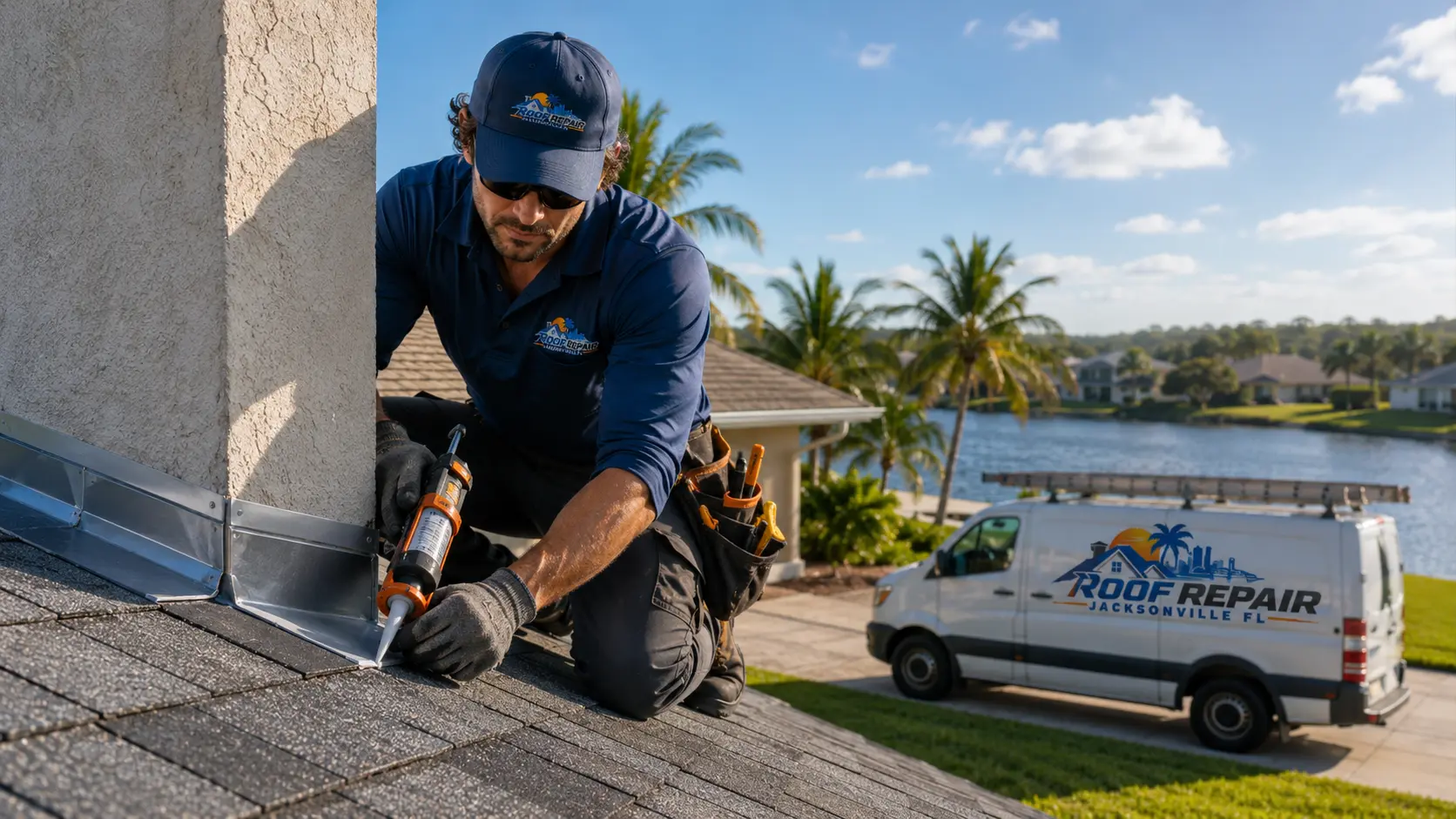
Flashing repair means restoring that geometry. Sometimes that is replacing a corroded section and re-integrating it with shingle courses; sometimes it is rebuilding a chimney detail with proper step and counter flashing rather than adding another layer of sealant on top of a failing one.
Where flashing fails
Chimneys are the classic problem area. A masonry chimney needs step flashing up each side, a front apron, a back pan or cricket, and counter flashing set into the masonry. When any of those pieces is missing or has been replaced with sealant, water enters at the transition and often shows up as a stain on the ceiling near the chimney chase.
Roof-to-wall transitions are similar. Step flashing must be woven into each shingle course and lapped by the wall's water barrier or counter flashing. Where siding or stucco was installed over the flashing incorrectly, or where the flashing has corroded at the bottom edge, water gets behind the assembly and travels down inside the wall.
Valleys carry the highest water volume on the roof. Debris in a valley holds moisture against the metal and shingle edges; corroded or short valley metal, or improperly cut shingles, lets that concentrated flow under the covering. Vent flanges and skylight head flashing fail the same way — because water was allowed to run under a lap instead of over it.
Warning signs to watch for
- Ceiling stains near a chimney, wall, or skylight
- Visible rust, pinholes, or splitting on flashing metal
- Cracked, shrunken, or peeling sealant beads
- Gaps between flashing and masonry or siding
- Debris packed into a valley
- Loose or lifted flashing edges after wind
- Staining on the exterior wall below the roof line
- Efflorescence or damp masonry at a chimney base
Common causes
- Sealant used in place of proper lapped flashing
- Corrosion, accelerated by salt air near the coast
- Thermal movement working fasteners and joints loose
- Incorrect lapping during original installation or a prior repair
- Siding or stucco applied over flashing rather than lapping it
- Debris accumulation in valleys and behind chimneys
- Wind lifting unsecured flashing edges
How it works
The repair process
A straightforward sequence, with no pressure to replace a roof that can be repaired.
- 1
Describe the leak location
Stains near a chimney, wall, or skylight strongly suggest a flashing detail rather than a field-of-roof problem.
- 2
Inspect the transition
Flashing pieces, laps, sealant condition, masonry or siding interface, and drainage into and out of the detail are examined.
- 3
Explain what failed
You learn whether the repair is a section replacement, a re-lap, or a rebuild of the detail, and why.
- 4
Rebuild the detail
Flashing is repaired or replaced so water is directed back onto the roof covering, with sealant as a secondary measure.
Roof types this applies to
- Shingle roofs — step, apron, counter, and valley flashing woven into courses.
- Metal roofs — panel-specific flashing, closures, and curb details.
- Flat and low-slope roofs — base flashing, counter flashing, and membrane terminations at walls and curbs.
- Tile roofs — pan flashing and valley details beneath the tile.
Jacksonville considerations
Sealant life is short in this climate. Direct sun, high surface temperatures, and daily thermal cycling shrink and harden sealant beads years before shingles are worn out. Details that were sealed rather than properly flashed tend to become the first leaks on an otherwise healthy roof.
Corrosion is a bigger factor closer to the water. Homes in Jacksonville Beach, Atlantic Beach, Neptune Beach, and along the Intracoastal see salt-laden air that shortens the life of galvanized metal and fasteners. Flashing that would last decades inland can show rust-through much sooner in those areas.
Wind-driven rain is the test that flashing details either pass or fail. A detail can shed ordinary rainfall for years and then leak during a tropical system because water is being pushed uphill into a lap. That is why flashing repairs focus on lap direction and coverage rather than on adding more sealant.
What affects the cost
Repair pricing depends on the specifics of the roof, not a flat rate. These are the factors that move it.
- Which detail is involved — an apron differs from a full chimney rebuild
- Whether masonry work or siding removal is required for access
- Length of valley or wall transition affected
- Metal type specified for the location and exposure
- Number of shingle courses that must be lifted and re-integrated
- Roof pitch, height, and access
- Condition of decking and underlayment beneath the detail
For planning ranges, see the Jacksonville roof repair cost guide. Any figure there is a planning estimate, not a quote.
FAQs
Flashing Repair questions
Can roof flashing be repaired, or does it need replacing?
Both are common outcomes. A localized section with intact geometry can sometimes be re-secured and re-sealed. When metal is corroded through, or when the original detail relies on sealant instead of proper laps, replacing the flashing is the repair that lasts. Adding sealant over a failing detail may stop a leak temporarily, but it usually returns within a season or two in Florida conditions.
Why does my chimney leak only in certain storms?
Chimney details are directional. Water pushed against one face by wind can get behind counter flashing or under a back pan that handles vertical rain without trouble. That is why a chimney can be dry for months and then leak during a storm from a particular direction. The fix is correcting the lap and coverage on the affected side, not sealing the visible joint.
Is caulk a real fix for flashing?
Sealant is a supporting material, not a substitute for flashing. It has a limited service life in direct sun and it cannot make up for water running under a lap. A durable repair puts the metal back in the right relationship — upper pieces over lower pieces, everything shedding onto the covering — and uses sealant only where the detail calls for it.
Does skylight flashing need special attention?
Skylights add curbs and head flashing to the roof plane, so they concentrate water at their top edge and along their sides. Where applicable, the repair addresses the head flashing, side step flashing, and curb-to-roof transition. Older skylights may also have deteriorated seals in the unit itself, which is a glazing issue rather than a roofing one and is assessed separately.
How can I tell flashing is the source of my leak?
Location is the best clue. Stains near a chimney chase, along the top of a wall where a roof meets a two-story section, around a skylight, or in line with a valley all point to a transition rather than the open field of the roof. Intermittent leaks tied to wind direction also suggest flashing. Confirming it requires looking at the detail and, when possible, the attic side.
Related roof repair services
Roof Leak Repair
Roof leak repair in Jacksonville, FL. Ceiling stains, attic moisture, pipe boot and flashing leaks located and repaired. Call 904-844-0026 about your roof leak.
Learn moreRoof Repair
Roof repair in Jacksonville, FL for leaks, damaged shingles, flashing failures, storm damage, metal and flat roofs. Call 904-844-0026 to discuss your roof.
Learn moreMetal Roof Repair
Metal roof repair in Jacksonville, FL for loose fasteners, failed sealants, standing seam issues, penetrations and corrosion. Call 904-844-0026 for help.
Learn moreShingle Roof Repair
Shingle roof repair in Jacksonville, FL for lifted, cracked and missing shingles, wind damage and exposed fasteners. Call 904-844-0026 to discuss your shingle roof.
Learn moreAreas served
- Southside
- Deerwood
- Baymeadows
- Mandarin
- Bartram Park
- San Marco
- Riverside
- Arlington
- Intracoastal West
- Jacksonville Beach
- Atlantic Beach
- Neptune Beach
Not sure if your address is covered? Call 904-844-0026 and ask.
Discuss your flashing repair question
Describe what you are seeing and where, and get clear next steps for the repair.
Call for current availability.