Metal Roof Repair Jacksonville FL
Metal roofs are durable, but they move. Most metal roof repairs involve fasteners, sealants, closures, and penetrations rather than the panels themselves.
The short answer
What to know first
Metal expands and contracts significantly with temperature, and Jacksonville delivers a large daily swing on a sun-exposed roof. That movement is what loosens exposed fasteners, fatigues sealant at penetrations, and works closures out of position at ridges and eaves. Panels often remain in good condition while the details around them need attention.
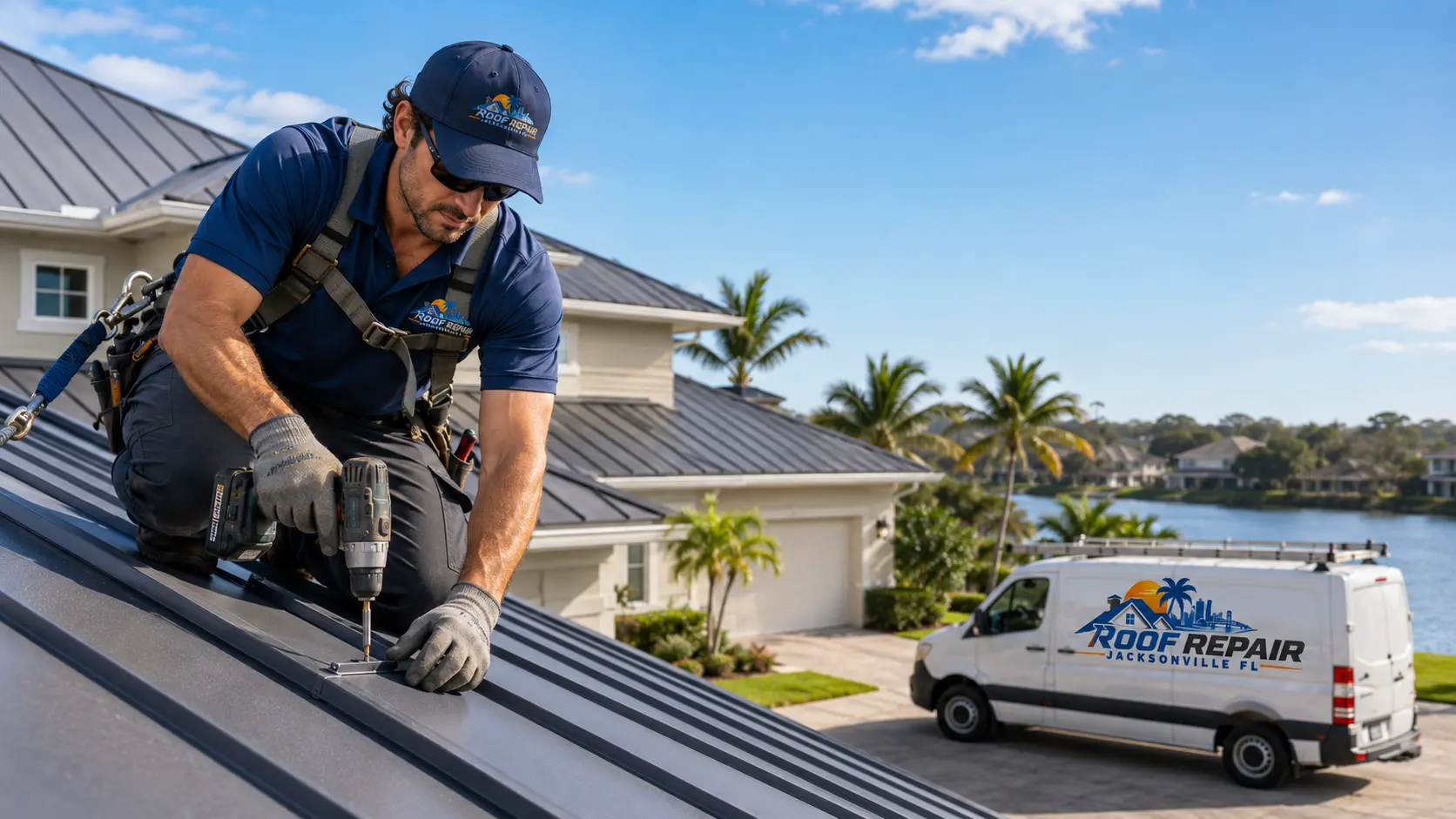
Repair approach depends on the system. Exposed-fastener panels are repaired at the fastener and washer level, along with laps and closures. Standing-seam systems rely on concealed clips and formed seams, so repairs focus on penetrations, flashings, and seam integrity, and require care not to compromise the panel movement the system depends on.
How metal roofs develop leaks
On exposed-fastener roofs, each screw has a rubber washer that seals the hole. Thermal cycling backs screws out slightly, compresses and cracks washers, and eventually leaves hundreds of small potential entry points. Over-driven screws are just as problematic as loose ones, because the washer has already been damaged.
Sealant at penetrations is the second common failure. Pipe flashings, curb details, and panel-end laps rely on sealant that degrades under UV. Because these details sit in the water path, small failures produce noticeable leaks quickly.
Standing-seam systems fail less often at the seam and more often where something interrupts the panel: a pipe, a curb, a satellite mount, or a poorly executed flashing. Fasteners driven through panels by other trades are a recurring cause of leaks on otherwise sound standing-seam roofs.
Corrosion is a real factor in coastal Jacksonville. Salt air attacks cut edges, scratches, fastener heads, and areas where dissimilar metals contact each other. Ponding behind a curb or in a valley accelerates the process, and once the coating is compromised the panel deteriorates from that point outward.
Warning signs to watch for
- Screw heads standing above the panel surface
- Rust staining around fasteners, laps, or cut edges
- Cracked, shrunken, or missing sealant at penetrations
- Ridge or eave closures displaced or missing
- Oil canning that has progressed to distorted or loose panels
- Leaks appearing near curbs, pipes, or roof-mounted equipment
- Panel edges lifted after high wind
- Water staining on interior ceilings below a penetration
Common causes
- Thermal expansion and contraction working fasteners loose
- UV degradation of sealants and washers
- Salt air corrosion near the beaches and Intracoastal
- Fasteners installed by other trades through panels
- Wind uplift at eaves, rakes, and ridges
- Debris and ponding behind curbs and in valleys
- Dissimilar metal contact causing galvanic corrosion
How it works
The repair process
A straightforward sequence, with no pressure to replace a roof that can be repaired.
- 1
Identify the system and symptom
Exposed-fastener or standing seam, and where the leak or damage appears. Panel profile affects the repair method.
- 2
Inspect fasteners, seams, and penetrations
Fastener condition, closures, laps, sealant, flashings, and any added roof-mounted equipment are all checked.
- 3
Review the repair plan
You get a clear explanation of whether the work is fastener-level, sealant and flashing, or panel replacement.
- 4
Complete the repair
Work respects the panel movement the system relies on, with materials compatible with the existing metal and coating.
Roof types this applies to
- Exposed-fastener panels — 5V crimp, ribbed, and similar profiles common on homes and outbuildings.
- Standing-seam panels — concealed-clip systems where penetrations and flashings drive most repairs.
- Metal over low-slope transitions — where metal meets a membrane or built-up section.
- Metal flashing and trim — ridge, hip, rake, eave, and valley components.
Jacksonville considerations
Metal has become popular in the Jacksonville market for wind performance and longevity, and it generally delivers. The trade-off is that its details need periodic attention rather than none at all — particularly fasteners and sealants on exposed-fastener roofs, which are consumables in a high-UV, high-heat climate.
Coastal exposure is the main regional variable. Salt reaches well inland on the sea breeze, and homes in the beaches communities and along the Intracoastal see faster corrosion at cut edges, fastener heads, and scratches. Selecting compatible metals and coatings for repairs matters more here than in inland markets.
Wind events test panel attachment at edges. After a significant storm, eaves, rakes, and ridge closures are worth inspecting even when the field of the roof looks untouched, because that is where uplift pressure concentrates.
What affects the cost
Repair pricing depends on the specifics of the roof, not a flat rate. These are the factors that move it.
- Panel type and profile, and whether matching material is available
- Number of fasteners or the area requiring re-fastening
- Extent of sealant and flashing work at penetrations
- Whether panel sections must be removed and replaced
- Corrosion extent and whether coating repair is practical
- Roof pitch, height, and access
- Compatibility requirements for metals and fasteners used
For planning ranges, see the Jacksonville roof repair cost guide. Any figure there is a planning estimate, not a quote.
FAQs
Metal Roof Repair questions
Can metal roofs be repaired, or do panels have to be replaced?
Most metal roof problems are repaired without replacing panels. Fastener replacement with correctly sized screws and new washers, renewed sealant at penetrations, and corrected flashing solve a large share of leaks. Panel replacement becomes appropriate where metal is corroded through, badly deformed by impact or wind, or where a penetration was cut incorrectly. On standing-seam roofs, panel work is more involved because of how panels interlock.
Why are the screws on my metal roof backing out?
Metal panels expand and contract with temperature, and that repeated movement gradually works exposed fasteners loose. Screws that were over-driven at installation also fail early because the rubber washer was crushed. On older exposed-fastener roofs, re-fastening with slightly larger-diameter screws and fresh washers is a common maintenance repair that addresses many small potential leak points at once.
Does salt air damage metal roofs in Jacksonville?
It shortens the life of exposed metal, especially at cut edges, scratches, and fastener heads, and it accelerates galvanic corrosion where dissimilar metals touch. Homes near the beaches and the Intracoastal are the most affected. Repairs in those areas should use compatible metals and fasteners, and any coating damage is worth addressing before corrosion spreads from that point.
Can a satellite dish or solar mount cause a metal roof leak?
Frequently. Anything fastened through a metal panel creates a penetration that needs proper flashing and, on standing-seam roofs, an attachment method that does not pierce the panel at all. Leaks appearing near roof-mounted equipment usually trace to that attachment rather than to the roof system itself, and the repair includes correcting how the equipment is mounted.
Is oil canning a defect that needs repair?
Mild waviness in flat metal areas is an aesthetic characteristic of the material, not a leak. It becomes a repair concern when panels are visibly distorted, loose, or have been deformed by wind or impact, because attachment and drainage can be affected. An inspection distinguishes normal appearance from panel movement that needs correction.
Related roof repair services
Flashing Repair
Roof flashing repair in Jacksonville, FL for chimneys, walls, valleys, vents and skylight transitions. Corroded metal and failed sealant. Call 904-844-0026.
Learn moreStorm Damage Roof Repair
Storm damage roof repair in Jacksonville, FL after wind, tropical storms and debris impact. Temporary protection and permanent repairs. Call 904-844-0026.
Learn moreRoof Repair
Roof repair in Jacksonville, FL for leaks, damaged shingles, flashing failures, storm damage, metal and flat roofs. Call 904-844-0026 to discuss your roof.
Learn moreFlat Roof Repair
Flat roof repair in Jacksonville, FL for membrane damage, ponding water, open seams, penetrations and drainage problems. Call 904-844-0026 to discuss your roof.
Learn moreAreas served
- Southside
- Deerwood
- Baymeadows
- Mandarin
- Bartram Park
- San Marco
- Riverside
- Arlington
- Intracoastal West
- Jacksonville Beach
- Atlantic Beach
- Neptune Beach
Not sure if your address is covered? Call 904-844-0026 and ask.
Discuss your metal roof repair question
Describe what you are seeing and where, and get clear next steps for the repair.
Call for current availability.