Flat Roof Repair Jacksonville FL
Flat and low-slope roofs do not shed water quickly, so every seam, termination, and drain has to work. Most repairs address those details rather than the middle of the field.
The short answer
What to know first
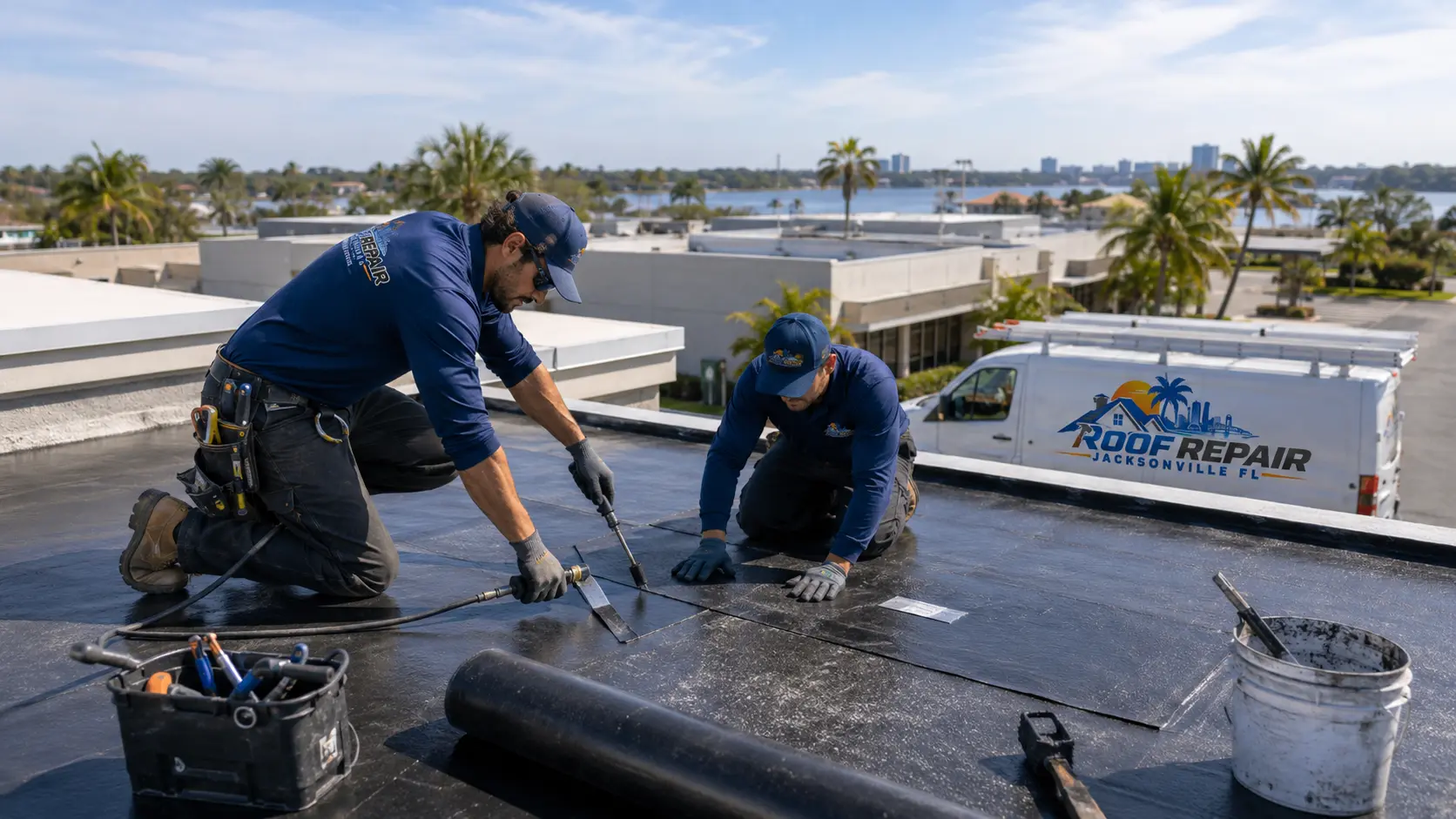
Low-slope roofs are membrane systems: modified bitumen, TPO, EPDM, or built-up assemblies. Water sits on them longer than on a sloped roof, which means a defect that would be minor on a shingle roof becomes a steady leak here. Repair work concentrates on seams, laps, flashing at walls and curbs, penetrations, and drainage.
Ponding is the recurring theme. Where water stands after rain, membranes and adhesives age faster, debris collects, and small punctures find their way through. Correcting drainage or adding positive slope where practical is often as important as patching the leak itself.
Common low-slope roof problems
Seams and laps carry most of the risk. Heat-welded or adhered laps can open at edges over time, particularly where foot traffic, thermal movement, or prior repairs have stressed them. An open lap in a ponding area leaks with every rain.
Penetrations and curbs are the second focus. HVAC curbs, vent pipes, drains, conduit supports, and skylight curbs all require base flashing that is properly terminated and sealed. On older roofs these details are commonly the first to fail, and they are also where repeated patching accumulates.
Punctures and membrane damage come from foot traffic, dropped tools, service work on rooftop equipment, and storm debris. On roofs with regular equipment service, damage often appears in a traffic pattern between the access point and the units.
Drainage problems compound everything. Blocked internal drains, undersized scuppers, clogged overflow outlets, and sagging deck areas all extend the time water sits on the roof. Ponding adds weight, accelerates aging, and pushes water against details designed for brief exposure.
Warning signs to watch for
- Water standing on the roof more than a day or two after rain
- Blisters, ridges, or soft spots underfoot
- Open, lifted, or fishmouthed seams
- Cracked or separated flashing at walls and curbs
- Debris around drains and scuppers
- Interior stains near the building perimeter or below equipment
- Membrane punctures, tears, or exposed reinforcement
- Sealant failure at pipe penetrations and pitch pans
Common causes
- Aging adhesives and weld failure at laps
- Ponding water from blocked or undersized drainage
- Foot traffic and mechanical damage from equipment service
- Thermal cycling stressing terminations and flashing
- Storm debris impact and wind uplift at edges
- Failed pitch pans and improperly detailed penetrations
- Prior patch repairs applied over wet or dirty membrane
How it works
The repair process
A straightforward sequence, with no pressure to replace a roof that can be repaired.
- 1
Report the symptoms
Where the interior leak appears, whether water ponds on the roof, and what equipment or penetrations are nearby.
- 2
Inspect membrane and details
Seams, flashings, terminations, penetrations, drains, and ponding areas are examined, along with signs of trapped moisture.
- 3
Review options
You get an explanation of whether targeted repair is appropriate or whether the assembly shows broader saturation.
- 4
Repair the detail
Work uses materials compatible with the existing membrane, with attention to drainage so the repair is not left sitting in water.
Roof types this applies to
- Modified bitumen — torch, mop, or self-adhered systems common on residential additions and small commercial buildings.
- TPO and single-ply — heat-welded seams, where lap and termination integrity is central.
- EPDM — adhered systems where seam tape and flashing details drive repairs.
- Built-up roofing — multi-ply assemblies with gravel or coated surfaces.
- Low-slope transitions — where a flat section meets a shingle or metal slope.
Jacksonville considerations
Rainfall intensity is the defining local factor. A Jacksonville summer downpour can put a lot of water on a low-slope roof in a short window, so drains and scuppers have to be clear and adequately sized. Roofs that drain slowly develop ponding areas that age the membrane and stress every detail within them.
Heat and UV are the second factor. Surface temperatures on a dark low-slope roof get high, which drives thermal movement at terminations and accelerates aging of adhesives and sealants. Reflective surfaces perform better here, and repair materials should be selected for that exposure.
Flat sections are common on Jacksonville homes as porch, addition, and carport roofs, and on light-commercial buildings across Southside and Arlington. Those small residential low-slope areas are often the least maintained part of the roof and a frequent source of persistent leaks.
What affects the cost
Repair pricing depends on the specifics of the roof, not a flat rate. These are the factors that move it.
- Membrane type and compatibility of repair materials
- Size of the damaged area and number of separate repairs
- Whether insulation below the membrane is saturated
- Drainage corrections included in the work
- Access to the roof and staging for materials
- Detail complexity at curbs, pitch pans, and equipment
- Whether temporary protection is needed first
For planning ranges, see the Jacksonville roof repair cost guide. Any figure there is a planning estimate, not a quote.
FAQs
Flat Roof Repair questions
Can flat roofs be repaired instead of replaced?
Yes, when the damage is localized and the insulation below is still dry. Seam repairs, patching, flashing corrections, and drainage improvements resolve many low-slope leaks. Replacement enters the conversation when moisture has saturated the insulation over a wide area, when the membrane has failed broadly from age, or when repeated repairs at multiple locations are no longer holding.
Is ponding water on a flat roof a problem?
Standing water that remains more than a day or two is a maintenance issue. It adds weight, holds debris, promotes biological growth, and accelerates membrane and adhesive aging, and it keeps pressure on seams and flashings that were designed for brief exposure. Clearing drains, correcting blocked scuppers, and improving slope where practical are common parts of a durable flat roof repair.
Why does my flat roof leak in a different place than the damage?
Water spreads laterally between the membrane and the deck, or through saturated insulation, before finding a fastener hole or deck joint to pass through. The interior stain can be well away from the entry point, which is why inspection covers the whole drainage area above the leak rather than just the ceiling location, and why moisture in the insulation matters to the repair plan.
Can a coating fix a leaking flat roof?
Coatings can extend the service life of a sound membrane and improve reflectivity, but they are not a repair for open seams, wet insulation, or failed flashings. Applying a coating over an active leak or saturated assembly traps moisture and hides the problem. Correct the defects first, then consider a coating as maintenance if the assembly is suitable.
Do you work on small commercial buildings?
Help is available for common light-commercial low-slope systems as well as residential flat sections such as porches, additions, and carports. Larger or specialized assemblies are assessed case by case. Call 904-844-0026 and describe the building, membrane type if known, and where the leak appears.
Related roof repair services
Roof Leak Repair
Roof leak repair in Jacksonville, FL. Ceiling stains, attic moisture, pipe boot and flashing leaks located and repaired. Call 904-844-0026 about your roof leak.
Learn moreFlashing Repair
Roof flashing repair in Jacksonville, FL for chimneys, walls, valleys, vents and skylight transitions. Corroded metal and failed sealant. Call 904-844-0026.
Learn moreRoof Repair
Roof repair in Jacksonville, FL for leaks, damaged shingles, flashing failures, storm damage, metal and flat roofs. Call 904-844-0026 to discuss your roof.
Learn moreMetal Roof Repair
Metal roof repair in Jacksonville, FL for loose fasteners, failed sealants, standing seam issues, penetrations and corrosion. Call 904-844-0026 for help.
Learn moreAreas served
- Southside
- Deerwood
- Baymeadows
- Mandarin
- Bartram Park
- San Marco
- Riverside
- Arlington
- Intracoastal West
- Jacksonville Beach
- Atlantic Beach
- Neptune Beach
Not sure if your address is covered? Call 904-844-0026 and ask.
Discuss your flat roof repair question
Describe what you are seeing and where, and get clear next steps for the repair.
Call for current availability.