Shingle Roof Repair Jacksonville FL
Asphalt shingles are the most common roof covering in Jacksonville, and most shingle problems are localized: a wind-damaged slope, a few cracked tabs, or fasteners that have worked loose over time.
The short answer
What to know first
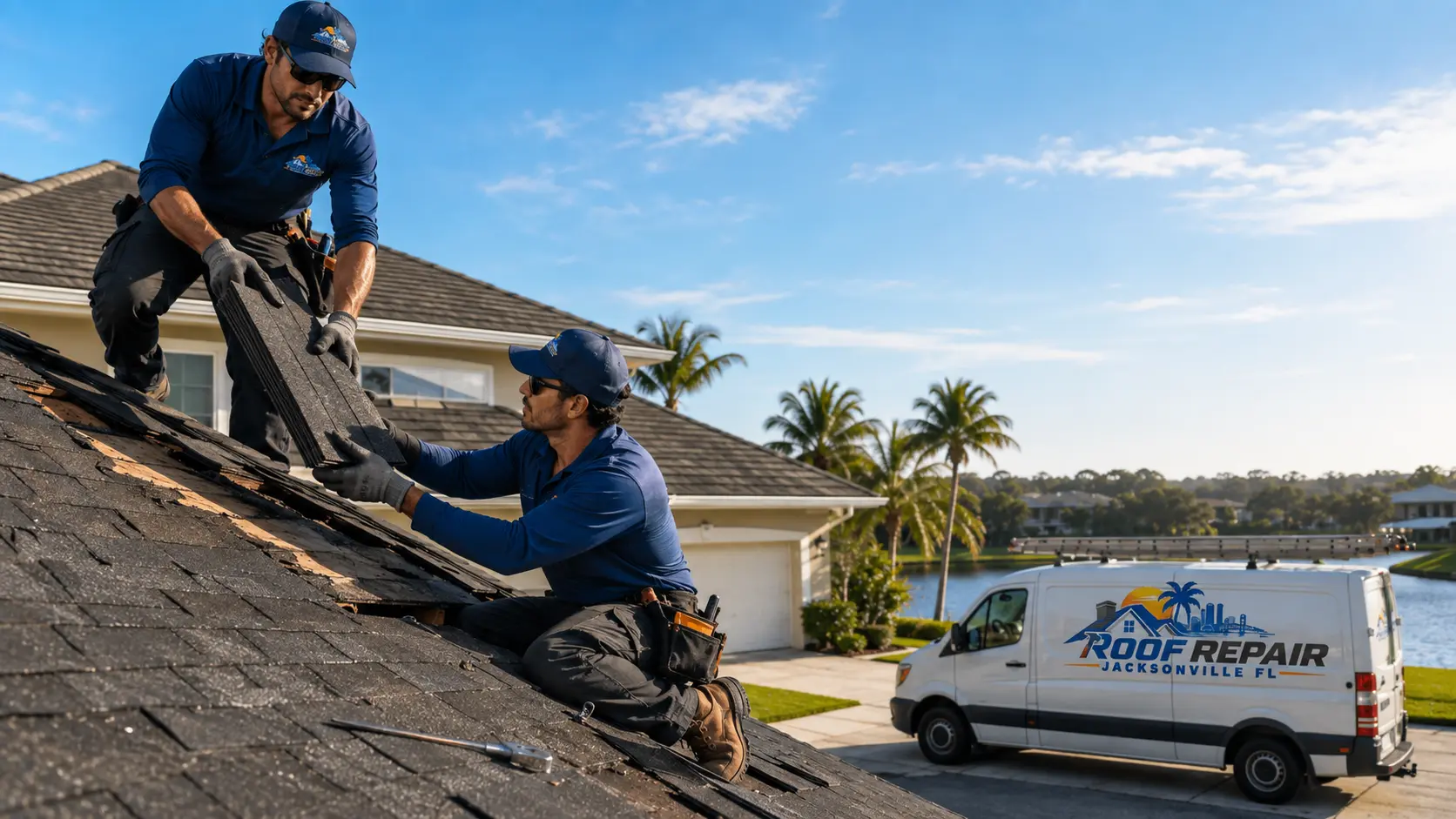
Shingle repair replaces damaged material and restores the interlocking, sealed relationship between courses. Each shingle is nailed through the course below and bonded to the one beneath it by a sealant strip that softens in the heat and adheres. When wind breaks that bond, tabs flutter, water gets under the course, and fasteners begin to loosen.
The practical question is whether the surrounding shingles are still sound enough to work with. Shingles that are pliable and have most of their granule surface can be lifted and re-integrated with new material. Brittle, heavily granule-worn shingles crack when handled, which limits what a localized repair can achieve.
Common shingle problems on Jacksonville homes
Wind damage is the leading cause of shingle repair calls. Sustained gusts break the sealant bond along a course, particularly along rakes, ridges, and the windward slope. The shingles may still be in place but no longer sealed, which leaves the roof vulnerable to the next storm and to wind-driven rain.
Missing shingles are the visible version of the same problem. Once a tab is gone, the underlayment is exposed to direct UV and rain, and the fasteners of adjacent shingles are exposed as well. Underlayment is a temporary water barrier, not a roof covering, so exposed areas should be addressed promptly.
Cracking and granule loss are age and heat related. Florida sun drives thermal cycling that eventually makes asphalt brittle. Granules protect the asphalt from UV; once they wash into gutters in quantity and bald spots appear, the shingle ages faster. Localized repairs still make sense in many of these roofs, but the condition of the surrounding field determines how well a repair blends and holds.
Exposed fasteners are a frequently overlooked issue. Nails that were over-driven, under-driven, or placed too high in the shingle can back out with thermal movement, creating small holes above the sealing line. These are inexpensive to correct and easy to miss without a close look at the roof.
Warning signs to watch for
- Shingle tabs lifting or fluttering in wind
- Missing tabs leaving exposed black underlayment
- Cracked, curled, or brittle shingle edges
- Bald patches where granules have washed away
- Granules accumulating in gutters and at downspouts
- Nail heads visible on the shingle surface
- Dark streaks along the eaves after wind events
- Ridge cap shingles loose, cracked, or displaced
Common causes
- Wind uplift breaking the sealant bond between courses
- Storm debris impact cracking or gouging shingles
- UV and heat cycling making asphalt brittle
- Fasteners placed incorrectly during original installation
- Foot traffic on a hot roof damaging soft shingles
- Overhanging limbs abrading the surface
- Poor attic ventilation increasing heat load on the covering
How it works
The repair process
A straightforward sequence, with no pressure to replace a roof that can be repaired.
- 1
Describe what you can see
Which slope, whether tabs are missing or just lifted, and whether it followed a storm. Photos from the ground help.
- 2
Evaluate condition and extent
The affected slope is checked for sealant failure, cracking, fastener issues, and whether adjacent shingles are workable.
- 3
Review repair options
You get an explanation of what can be repaired locally, and an honest note if broader deterioration limits the value of patching.
- 4
Complete the repair
Damaged shingles are replaced, courses re-nailed and sealed where required, and penetrations and flashing in the area checked.
Roof types this applies to
- Three-tab shingles — older roofs where matching material and color is harder and tabs crack more readily.
- Architectural / laminated shingles — the current standard on most homes, generally more repair-friendly.
- Ridge and hip cap shingles — a common repair area after wind events.
- Starter courses and rake edges — where uplift usually begins.
Jacksonville considerations
Jacksonville shingle roofs face a specific combination: high UV load most of the year, heat that pushes attic and roof-surface temperatures up, and periodic high wind. Heat softens the sealant strip, which normally helps shingles bond, but repeated expansion and contraction also works fasteners loose and hardens the asphalt over time.
Wind exposure varies by location. Homes near the beaches and along the Intracoastal see stronger sustained wind and salt in the air; inland neighborhoods with heavy tree cover trade some wind exposure for more debris and abrasion. Both patterns produce shingle repairs, just for different reasons.
Color matching is a practical consideration on older roofs. Shingles weather and fade, and some product lines have been discontinued, so a repair may be visible even when the work itself is sound. Repairs on a less prominent slope usually blend acceptably; on a highly visible front slope it is worth discussing expectations up front.
What affects the cost
Repair pricing depends on the specifics of the roof, not a flat rate. These are the factors that move it.
- Number of shingles and the size of each affected area
- Whether ridge or hip cap work is included
- Availability of matching shingle color and profile
- Condition of surrounding shingles and how workable they are
- Roof pitch, height, and access
- Whether underlayment or decking is damaged underneath
- Additional flashing or penetration work found in the same area
For planning ranges, see the Jacksonville roof repair cost guide. Any figure there is a planning estimate, not a quote.
FAQs
Shingle Roof Repair questions
Can missing shingles just be replaced?
Usually, yes. New shingles are woven into the existing courses, nailed correctly, and sealed so the area sheds water like the rest of the slope. The main limits are the condition of the neighboring shingles — brittle material tends to crack when lifted — and matching. Where the original product is discontinued, a close match is used and placement is discussed so the repair is as visually consistent as practical.
My shingles are lifted but nothing is missing. Is that a problem?
Yes. A shingle that is no longer bonded to the course below is not doing its job even though it looks fine from the ground. Wind can drive rain under an unsealed tab, and the next storm can remove it entirely. Re-securing and re-sealing affected courses is a comparatively small repair that protects the slope going forward.
How long do shingle roofs last in Florida?
Service life depends on product, installation quality, ventilation, and exposure. Florida heat and UV generally push asphalt shingles toward the shorter end of their rated range, and storm history matters as much as age. Rather than a fixed number, look at condition indicators: granule loss, brittleness, repeated leaks, and whether repairs are becoming frequent across multiple areas.
Will a repaired area match the rest of my roof?
Reasonably, but rarely perfectly. Existing shingles have weathered and faded, and manufacturers change product lines. A repair on a rear or side slope typically blends well. On a prominent front slope, it is worth setting expectations before work begins — some homeowners prefer to accept a slight difference, others prefer to discuss a broader plan.
Do exposed nail heads need attention?
They do. A fastener that has backed out creates a small hole above the shingle's sealing line, and each one is a potential entry point. Correcting exposed fasteners is straightforward and is normally handled as part of a shingle repair, along with checking whether nearby fasteners are showing the same pattern.
Related roof repair services
Storm Damage Roof Repair
Storm damage roof repair in Jacksonville, FL after wind, tropical storms and debris impact. Temporary protection and permanent repairs. Call 904-844-0026.
Learn moreRoof Leak Repair
Roof leak repair in Jacksonville, FL. Ceiling stains, attic moisture, pipe boot and flashing leaks located and repaired. Call 904-844-0026 about your roof leak.
Learn moreRoof Repair
Roof repair in Jacksonville, FL for leaks, damaged shingles, flashing failures, storm damage, metal and flat roofs. Call 904-844-0026 to discuss your roof.
Learn moreFlashing Repair
Roof flashing repair in Jacksonville, FL for chimneys, walls, valleys, vents and skylight transitions. Corroded metal and failed sealant. Call 904-844-0026.
Learn moreAreas served
- Southside
- Deerwood
- Baymeadows
- Mandarin
- Bartram Park
- San Marco
- Riverside
- Arlington
- Intracoastal West
- Jacksonville Beach
- Atlantic Beach
- Neptune Beach
Not sure if your address is covered? Call 904-844-0026 and ask.
Discuss your shingle roof repair question
Describe what you are seeing and where, and get clear next steps for the repair.
Call for current availability.