Roof Leak Repair Jacksonville FL
A roof leak is a symptom. The repair that lasts is the one that corrects the entry point, which is often several feet away from the stain on the ceiling and hidden behind a flashing detail or a penetration.
The short answer
What to know first
Leak repair starts with the water path. Water enters at a defect, travels along the top of the underlayment or the underside of the decking until it meets a fastener, seam, or framing member, and then drops. Following that path backwards — from stain, to attic evidence, to roof detail — is what separates a repair that holds from one that reappears at the next heavy rain.
Most residential leaks in this area trace back to a short list of details: plumbing vent boots, exhaust vent flanges, chimney and wall flashing, valleys, and shingle courses lifted or damaged by wind. Skylight curbs and roof-to-wall transitions round out the list on homes that have them.
How roof leaks actually happen
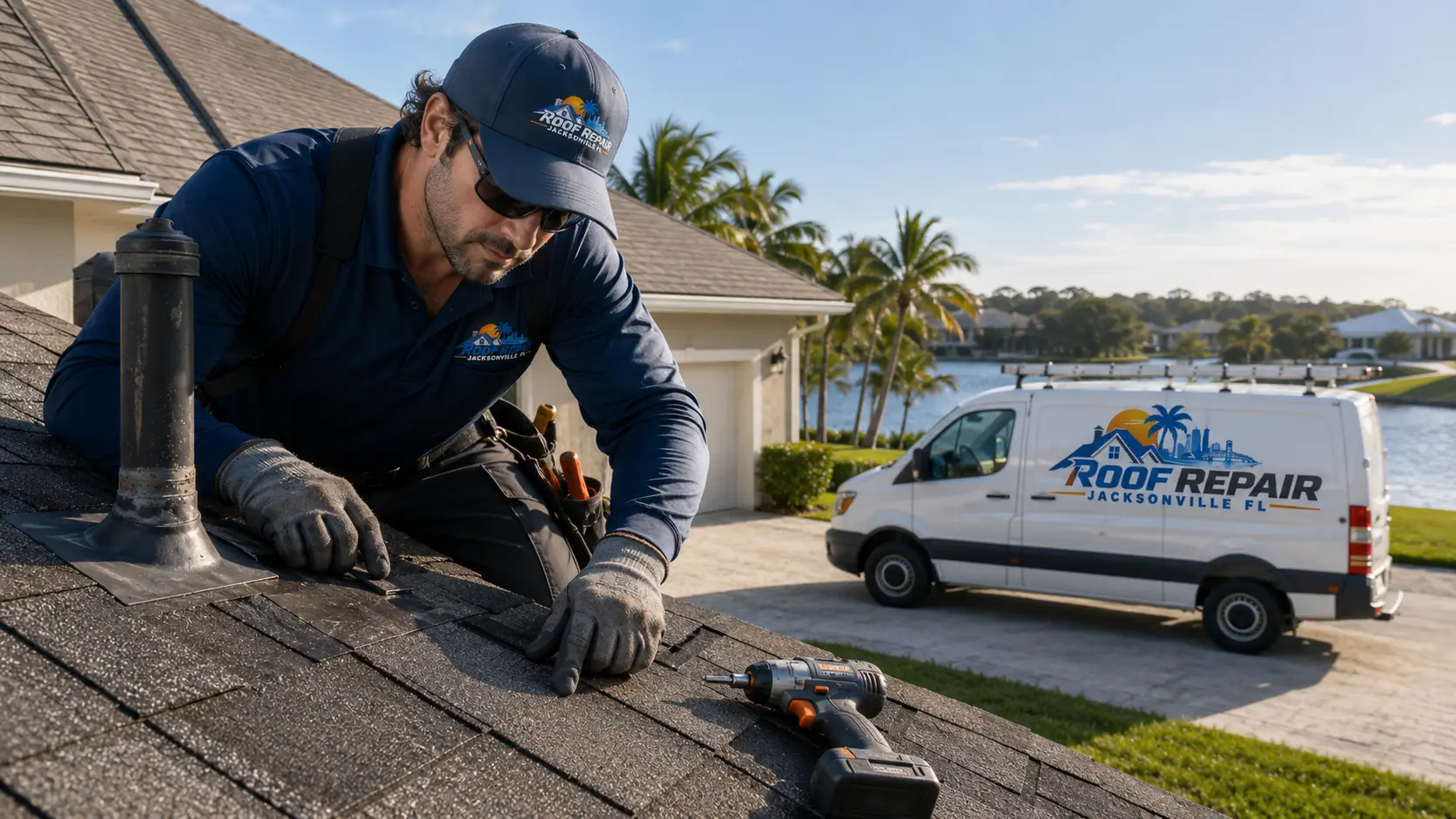
Pipe boots are the single most common culprit on shingle roofs. The rubber collar around a plumbing vent hardens and cracks after years of UV exposure, and once it splits, every rain sends water directly into the attic along the pipe. The stain often appears in a hallway or bathroom ceiling a few feet away.
Flashing failures come next. Step flashing at walls, counter flashing at chimneys, and valley metal all depend on correct lapping and intact sealant. When sealant shrinks or metal corrodes and separates, wind-driven rain gets behind the detail. These leaks are often intermittent — dry during a gentle shower, active during a storm from a particular direction.
Shingle-level problems create leaks when the sealant strip between courses has broken and wind lifts the tabs, when a tab is missing entirely, or when a nail has backed out and left a hole through the covering. Older roofs also develop brittle, cracked shingles that no longer shed water cleanly around penetrations.
Warning signs to watch for
- Brown or yellow ring stains on ceilings or at wall tops
- Bubbling paint or soft drywall after heavy rain
- Damp or compressed insulation in one area of the attic
- Dark streaking or water tracks on rafters and decking
- Musty odor in a closet, attic, or upstairs room
- Drips appearing only during wind-driven rain
- Water stains around a skylight, chimney, or vent
- Peeling paint on exterior soffits or fascia
Common causes
- Cracked or hardened plumbing vent boots
- Failed sealant and corroded chimney or wall flashing
- Damaged or improperly lapped valley metal
- Wind-lifted, cracked, or missing shingles
- Backed-out fasteners creating holes in the covering
- Exhaust vent flanges installed over, rather than under, shingle courses
- Skylight curb and head flashing deterioration
- Blocked gutters and valleys backing water up under the covering
How it works
The repair process
A straightforward sequence, with no pressure to replace a roof that can be repaired.
- 1
Describe the pattern
Which room, how large the stain, whether it only appears in heavy or wind-driven rain, and whether it has been patched before.
- 2
Trace the water path
Attic evidence and roof-side inspection are used together to locate the entry point rather than sealing the nearest visible feature.
- 3
Explain the repair options
You get a clear account of the failed detail and what correcting it involves, including whether surrounding materials need replacement.
- 4
Repair and verify
The detail is rebuilt so it sheds water correctly, with attention to lapping and how the repair integrates with the existing roof.
Roof types this applies to
- Shingle roofs — boots, flashing, valleys, and damaged courses are the usual leak points.
- Metal roofs — fastener holes, failed closures, and penetration flashing lead the list.
- Flat and low-slope roofs — seams, laps, terminations, and drain details.
- Tile roofs — the underlayment beneath the tile is the real water barrier and often the real leak source.
Jacksonville considerations
Two Jacksonville weather patterns drive most leak calls. The first is the summer convective downpour: a very high rainfall rate over a short period, which overwhelms marginal drainage and finds any gap in a valley or around a penetration. The second is wind-driven rain from tropical systems and coastal fronts, which pushes water sideways and uphill into laps that only work when water runs downhill.
Sun exposure sets the stage for both. Sustained UV and heat harden rubber boots and shrink sealants years before the shingles themselves are worn out, which is why a roof with plenty of remaining life can still develop several leak points at penetrations.
Humidity slows drying inside the assembly. Insulation that gets wet in June may still be damp weeks later, so leaks here cause interior damage faster than the same leak would in a drier climate. Homes with vaulted or closed ceilings make early detection harder, since there is no attic to inspect.
What affects the cost
Repair pricing depends on the specifics of the roof, not a flat rate. These are the factors that move it.
- How difficult the leak is to locate, especially with closed ceilings
- Which detail failed — a boot replacement differs from rebuilding chimney flashing
- Number of separate leak sources
- Roof pitch, height, and access
- Whether decking or underlayment must be replaced
- Materials required to match the existing covering
- Interior repairs, which are separate from the roof work itself
For planning ranges, see the Jacksonville roof repair cost guide. Any figure there is a planning estimate, not a quote.
FAQs
Roof Leak Repair questions
How do you find where a roof leak is coming from?
The search works backwards along the water path. The interior stain gives a starting point, attic evidence such as damp insulation or staining on decking and rafters narrows the area, and roof-side inspection of penetrations, flashing, valleys, and fasteners identifies the defect. When ceilings are closed and there is no attic access, the roof details above the affected area are examined systematically, prioritizing the failure points that cause most leaks.
Can a roof leak only happen during heavy rain?
Yes, and that is very common. Some defects only leak when rainfall rate is high enough to overwhelm a valley or gutter, or when wind pushes water up under a lap or behind flashing. A roof can stay dry during a gentle shower and leak steadily during a storm from one particular direction. Intermittent leaks are still real defects and tend to worsen as the failed detail continues to move and age.
What causes leaks around roof vents?
Plumbing vents rely on a rubber collar that seals against the pipe, and UV exposure eventually cracks it. Exhaust vents rely on a metal flange integrated into the shingle courses; if the flange was installed on top of the shingles below it, or if sealant was used in place of correct lapping, water gets underneath. Both are common, both are usually repairable, and both often show up as a stain a few feet from the vent.
Is a leak coming from the roof or from condensation?
Condensation problems usually appear as widespread dampness on the underside of the decking or on ductwork, often in cooler months or in poorly ventilated attics, and they are not tied to rainfall. Roof leaks are typically localized and correlate with rain events. Because both can stain a ceiling, evaluating the attic conditions along with the roof helps distinguish them before work begins.
Will you repair the ceiling damage too?
Roof work addresses the source of the water. Interior finish repairs such as drywall replacement, texture, and painting are a separate scope and are usually handled after the roof detail has been corrected and the affected materials have dried. It is worth waiting for the area to dry before closing it up so any remaining moisture is not sealed inside.
Related roof repair services
Flashing Repair
Roof flashing repair in Jacksonville, FL for chimneys, walls, valleys, vents and skylight transitions. Corroded metal and failed sealant. Call 904-844-0026.
Learn moreShingle Roof Repair
Shingle roof repair in Jacksonville, FL for lifted, cracked and missing shingles, wind damage and exposed fasteners. Call 904-844-0026 to discuss your shingle roof.
Learn moreEmergency Roof Repair
Active roof leak or storm damage in Jacksonville? Emergency roof repair help including temporary protection and tarping. Call 904-844-0026 for current availability.
Learn moreRoof Repair
Roof repair in Jacksonville, FL for leaks, damaged shingles, flashing failures, storm damage, metal and flat roofs. Call 904-844-0026 to discuss your roof.
Learn moreAreas served
- Southside
- Deerwood
- Baymeadows
- Mandarin
- Bartram Park
- San Marco
- Riverside
- Arlington
- Intracoastal West
- Jacksonville Beach
- Atlantic Beach
- Neptune Beach
Not sure if your address is covered? Call 904-844-0026 and ask.
Discuss your roof leak repair question
Describe what you are seeing and where, and get clear next steps for the repair.
Call for current availability.